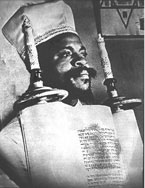
Rabbi W.A. Matthew – The Black Jews of Harlem
|
ברוּך
שׁנתן תוֹרה
לעמוֹ ישראל |
|
Blessed be He Who giveth to His people |
|
M |
y background and most of my information comes from working with
those congregations that derive from the late Chief Rabbi Wentworth Arthur
Matthew (1892-1973). Rabbi Matthew founded the Command-ment
Keepers Congregation in
The emergence of Judaism among people of African descent in the
first half of the Twen-tieth Century was made
possible by a combin-ation of the following factors:
(1) A strong religious tradition in the background of the person who became
Jewish that embodied Jewish practices from an early but unclear source. When
interviewed, many of the older members of this community recall memories of
their parents observing certain dietary laws, such as abstaining from pork or
salting their meat. Others recall traditions related to observing the Sabbath
or festivals such as Passover and Sukkot. In most
cases these practices were fragmentary and observed by people who simultaneously
practiced Christi-anity.
The possible origins of these Hebraic tradi-tions
could be traced to
Many African Americans who practice Juda-ism
today maintain that they have always had a close affinity with the Hebrews of
the Old Testament. This is true whether or not they recall particular rites
that remind them of the Jewish traditions they now follow. Scholars such as
Albert Raboteau have described in books such as Slave
Religion that the biblical struggles of the Hebrew people—particularly
their slavery and exodus from Egypt—bore a strong similarity to the conditions
of African slaves and was therefore of special importance to them. This close
identification with the biblical Hebrews is clearly seen in the lyrics of gospel
songs such as "Go Down Moses" and remains a
favorite theme in the sermons of black clergy today.
What all this proves is that there was a foundation – be it
psychological, spiritual, or historical – that made some black people receptive
to the direct appeal to Judaism that Rabbi Matthew and others made to them in this century. If black people were fertile ground for the
harbingers of Judaism, then the philosophy of Marcus Garvey was the seed that
helped to bring it to fruition. Put most simply, Garvey's message was one of
Black Nationalism and Pan Africanism. His goal was to
instill pride in a people who were being humiliated through institutionalized
racism and cultural bigotry. Garvey and Matthew attemp-ted to challenge old stereotypes that either
minimized a black presence in history or the Bible, or, that completely excised
black people from these texts. They argued that such distortions and
omissions were harmful to the self-image that many black people had of
themselves. They debunked these myths by extolling the contributions that black
people made to the development of human civiliza-tion.
To some extent this meant focusing on the achievements of African societies
such as
Rabbi Ford and Rabbi Matthew took Garvey's philosophy one step
further. They reasoned that if many of the ancient Hebrews were black, then
Judaism was as much a part of their cultural and religious heritage as is Christianity.
In their hearts and minds they were not converting to Judaism, they were
reclaiming part of their legacy. This fit very neatly with the biblical
prophecies that spoke of the Israelites being scattered all over the world,
being carried in slave ships to distant lands, and of being forced to worship
alien gods (Deuteronomy 28).
Rabbi Matthew found himself in the pecu-liar
position of having to both justify his small following of black Jews in
Rabbi Matthew believed that although the
"original Jews" were black people, white Jews had kept and preserved
Judaism over the centuries. Since we, black Jews, were just "returning"
to Judaism it was necessary for us to look to white Jews on certain
matters—particularly on post-biblical and rabbinic holi-days
such as Hanukkah which could not be found in the Torah. However, it is
important to note that Rabbi Matthew felt free to disagree on matters where he
had a strong objection. He also recognized that since many customs, songs, and
foods were of European origin, that he had the right to introduce some African,
EDITOR’S NOTE: This article is
reprinted from BlackJews.org. We are thrilled with African Americans
identifying so strongly with Judaism and the Jewish people. However, it is
unfortunate that these good people have adopted Judaism while rejecting the
Jewish Messiah!
The last sentence is somewhat dated. In recent years, many white
Jews have been seeking out and encouraging the Black Jewish people in our
midst. We recently attended a film documentary called The Commandment
Keepers completed by Elaine Glicksman for
Lost Tribes Films. This was shown at Temple Beth El a synagogue in
This documentary permitted us to see the
lives of these African-American Jews. It would be impossible to know how many
of them have Jewish blood coursing through their veins. However, it is obvious
that they are practicing Jews. We saw them rejoicing with a genuine Torah
scroll, and thoroughly cleaning for Pass-over. We saw many interviews with
different members of the Black Jewish community. We were especially impressed
with the spiritual fervor of these people. In this respect, white Jews could
learn much from these people. It would be far easier for them to simply find a
nice church to go to. However, they have chosen to cast their lot with the
Jewish community, making them a minority within a minority.
Via this film, we also got to “visit”
various Black Jewish congregations as well as some of the Black Rabbis in this
movement. We happen to have a Black Jewish synagogue on